
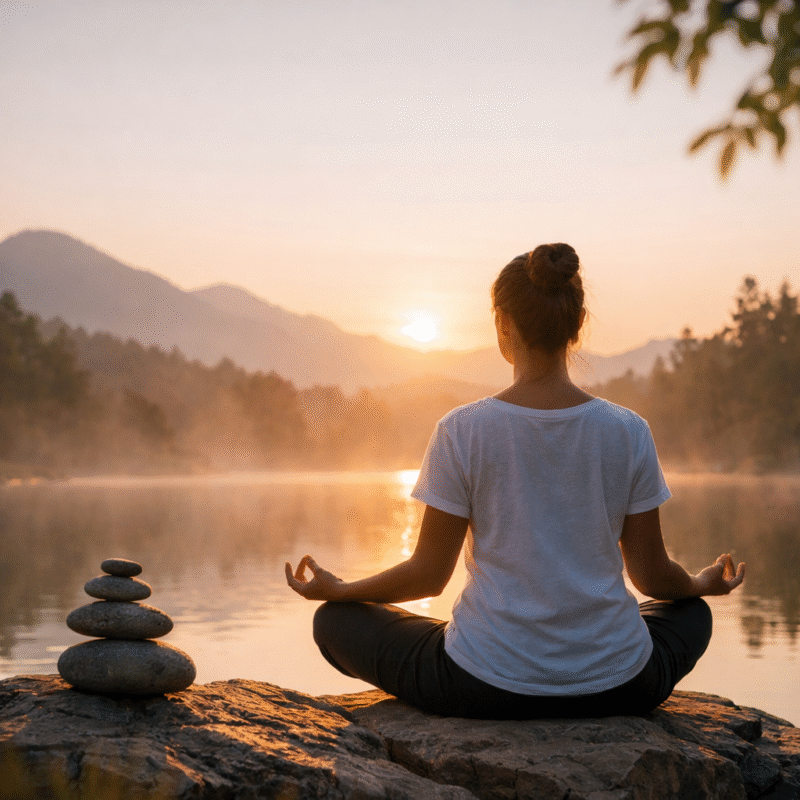
Life often feels like a race we never signed up for.
Our minds keep running between the past and the future — replaying what went wrong or overthinking what might happen next. In this constant mental noise, we forget the present moment — the only place where life actually happens.
This is where mindfulness gently enters our lives.
Not as a solution to eliminate all stress, but as a way to live with more awareness, ease, and balance.
Mindfulness is the practice of being fully present. It is not about escaping reality or forcing calmness. It is about becoming aware of your thoughts, emotions, and surroundings — without judgment.
What Is Mindfulness Really About?
At its core, mindfulness means paying attention with intention.
It is the practice of noticing:
- Your breath as it flows in and out
- Your thoughts as they arise and pass
- Your emotions without labeling them as good or bad
- Your body and how it feels in this moment
Mindfulness does not ask you to change anything immediately.
It simply invites you to observe — gently and honestly.
When awareness grows, change naturally follows.
Why Mindfulness Matters in Everyday Life
Mindfulness is not limited to meditation cushions or quiet rooms. It is meant to be lived — in conversations, work, relationships, and even difficult moments.
Practicing mindfulness can help you:
- Reduce stress and mental overload
- Respond thoughtfully instead of reacting impulsively
- Improve emotional balance and clarity
- Feel more grounded during uncertainty
- Develop a deeper connection with yourself
When you are mindful, life may not become easier — but you become stronger in how you face it.
Common Myths About Mindfulness
Many people hesitate to practice mindfulness because of common misunderstandings.
Let’s clear a few of them:
- “My mind is too busy.”
A busy mind is exactly why mindfulness helps. - “I don’t have time.”
Mindfulness takes moments, not hours. - “I must stop thinking.”
Mindfulness is about noticing thoughts, not stopping them.
Mindfulness meets you where you are — just as you are.
Simple Ways to Practice Mindfulness Every Day
You don’t need complex techniques. Start small.
1. Mindful Breathing
Pause for a minute and notice your breath. No control — just awareness.
2. Mindful Eating
Eat one meal without distractions. Taste, chew, and feel each bite.
No mobile. No TV.
3. Mindful Walking
Take a walk, preferably in nature. Notice your steps, your breathing, and the world around you.
4. Mindful Listening to Music
Listen to music you love. No multitasking — just listening.
5. Mindful Pauses
Before reacting, pause. One conscious breath can change everything.
My Personal Experience With Mindfulness
I used to feel constantly juggled by different thoughts. Whenever someone said something, I would overthink it, imagining countless meanings and interpretations. At times, my mind felt so crowded that I needed someone else to pull me back into the present moment.
Mindfulness taught me something simple yet powerful:
I don’t have to control every thought or emotion — I just need to notice them.
Over time, I began responding with more patience, understanding my emotions better, and finding peace even when life felt uncertain. The outer world didn’t change overnight — but my relationship with it did.
How Mindfulness Supports Inner Growth
Mindfulness is the doorway to inner growth.
When you become aware of your inner world, you begin to:
- Recognize patterns that no longer serve you
- Respond with compassion instead of criticism
- Choose peace over unnecessary conflict
- Grow emotionally without force
True growth begins with awareness.
Final Thoughts
Mindfulness is not a destination — it is a way of living.
A gentle reminder to return to the present moment, again and again.
You don’t need to be perfect.
You just need to be present.
If this resonates with you, take one mindful breath today — and let that be enough.